Brick
Brick

A single brick

A wall constructed in glazed-headed Flemish bond with bricks of various shades and lengths

Raw (green) Indian brick

An old brick wall in English bond laid with alternating courses of headers and stretchers

Block is a similar term referring to a rectangular building unit composed of similar materials, but is usually larger than a brick. Lightweight bricks (also called lightweight blocks) are made from expanded clay aggregate.
Fired bricks are one of the longest-lasting and strongest building materials, sometimes referred to as artificial stone, and have been used since circa 5000 BC. Air-dried bricks, also known as mudbricks, have a history older than fired bricks, and have an additional ingredient of a mechanical binder such as straw.
Bricks are laid in courses and numerous patterns known as bonds, collectively known as brickwork, and may be laid in various kinds of mortar to hold the bricks together to make a durable structure.
Contents
History

House construction using bricks in Kerala, India

The Roman Basilica Aula Palatina in Trier, Germany, built with fired bricks in the 4th century as an audience hall for Constantine I
Middle East and South Asia
The earliest bricks were dried brick, meaning that they were formed from clay-bearing earth or mud and dried (usually in the sun) until they were strong enough for use. The oldest discovered bricks, originally made from shaped mud and dating before 7500 BC, were found at Tell Aswad, in the upper Tigris region and in southeast Anatolia close to Diyarbakir.[1] Other more recent findings, dated between 7,000 and 6,395 BC, come from Jericho, Catal Hüyük, the ancient Egyptian fortress of Buhen, and the ancient Indus Valley cities of Mohenjo-daro, Harappa,[2] and Mehrgarh.[3] Ceramic, or fired brick was used as early as 3000 BC in early Indus Valley cities.[4]
The ancient Jetavanaramaya stupa in Anuradhapura, Sri Lanka is one of the largest brick structures in the world.


China
In pre-modern China, bricks were being used from the 2nd millennium BC at a site near Xi'an.[5] Bricks were produced on a larger scale under the Western Zhou dynasty about 3,000 years ago, and evidence for some of the first fired bricks ever produced has been discovered in ruins dating back to the Zhou.[6][7][8] The carpenter's manual Yingzao Fashi, published in 1103 at the time of the Song dynasty described the brick making process and glazing techniques then in use. Using the 17th century encyclopaedic text Tiangong Kaiwu, historian Timothy Brook outlined the brick production process of Ming Dynasty China:- "...the kilnmaster had to make sure that the temperature inside the kiln stayed at a level that caused the clay to shimmer with the colour of molten gold or silver. He also had to know when to quench the kiln with water so as to produce the surface glaze. To anonymous labourers fell the less skilled stages of brick production: mixing clay and water, driving oxen over the mixture to trample it into a thick paste, scooping the paste into standardised wooden frames (to produce a brick roughly 42 cm long, 20 cm wide, and 10 cm thick), smoothing the surfaces with a wire-strung bow, removing them from the frames, printing the fronts and backs with stamps that indicated where the bricks came from and who made them, loading the kilns with fuel (likelier wood than coal), stacking the bricks in the kiln, removing them to cool while the kilns were still hot, and bundling them into pallets for transportation. It was hot, filthy work."

The brickwork of Shebeli Tower in Iran displays 12th-century craftsmanship
Europe
Early civilisations around the Mediterranean adopted the use of fired bricks, including the Ancient Greeks and Romans. The Roman legions operated mobile kilns,[9] and built large brick structures throughout the Roman Empire, stamping the bricks with the seal of the legion.During the Early Middle Ages the use of bricks in construction became popular in Northern Europe, after being introduced there from Northern-Western Italy. An independent style of brick architecture, known as brick Gothic (similar to Gothic architecture) flourished in places that lacked indigenous sources of rocks. Examples of this architectural style can be found in modern-day Denmark, Germany, Poland, and Russia.
This style evolved into Brick Renaissance as the stylistic changes associated with the Italian Renaissance spread to northern Europe, leading to the adoption of Renaissance elements into brick building. A clear distinction between the two styles only developed at the transition to Baroque architecture. In Lübeck, for example, Brick Renaissance is clearly recognisable in buildings equipped with terracotta reliefs by the artist Statius von Düren, who was also active at Schwerin (Schwerin Castle) and Wismar (Fürstenhof).

Chile house in Hamburg, Germany
Industrial era
Production of bricks increased massively with the onset of the Industrial Revolution and the rise in factory building in England. For reasons of speed and economy, bricks were increasingly preferred as building material to stone, even in areas where the stone was readily available. It was at this time in London that bright red brick was chosen for construction to make the buildings more visible in the heavy fog and to help prevent traffic accidents.[10]The transition from the traditional method of production known as hand-moulding to a mechanised form of mass-production slowly took place during the first half of the nineteenth century. Possibly the first successful brick-making machine was patented by Henry Clayton, employed at the Atlas Works in Middlesex, England, in 1855, and was capable of producing up to 25,000 bricks daily with minimal supervision.[11] His mechanical apparatus soon achieved widespread attention after it was adopted for use by the South Eastern Railway Company for brick-making at their factory near Folkestone.[12] The Bradley & Craven Ltd ‘Stiff-Plastic Brickmaking Machine’ was patented in 1853, apparently predating Clayton. Bradley & Craven went on to be a dominant manufacturer of brickmaking machinery.[13] Predating both Clayton and Bradley & Craven Ltd. however was the brick making machine patented by Richard A. Ver Valen of Haverstraw, New York in 1852.[14]
The demand for high office building construction at the turn of the 20th century led to a much greater use of cast and wrought iron, and later, steel and concrete. The use of brick for skyscraper construction severely limited the size of the building – the Monadnock Building, built in 1896 in Chicago, required exceptionally thick walls to maintain the structural integrity of its 17 storeys.
Following pioneering work in the 1950s at the Swiss Federal Institute of Technology and the Building Research Establishment in Watford, UK, the use of improved masonry for the construction of tall structures up to 18 storeys high was made viable. However, the use of brick has largely remained restricted to small to medium-sized buildings, as steel and concrete remain superior materials for high-rise construction.[15]
Types

This wall in Beacon Hill, Boston shows different types of brickwork and stone foundations
Categorized by manufacture method:
- Extruded – made by being forced through an opening in a steel die, with a very consistent size and shape.
- Wire-cut – cut to size after extrusion with a tensioned wire which may leave drag marks
- Moulded – shaped in moulds rather than being extruded
- Machine-moulded - clay is forced into moulds using pressure
- Handmade - clay is forced into moulds by a person
- Dry-pressed - similar to soft mud method, but starts with a much thicker clay mix and is compressed with great force.
- Common or building – A brick not intended to be visible, used for internal structure
- Face – A brick used on exterior surfaces to present a clean appearance
- Hollow – not solid, the holes are less than 25% of the brick volume
- Perforated – holes greater than 25% of the brick volume
- Keyed – indentations in at least one face and end to be used with rendering and plastering
- Paving – brick intended to be in ground contact as a walkway or roadway
- Thin – brick with normal height and length but thin width to be used as a veneer
- Chemically resistant – bricks made with resistance to chemicals
- Acid brick – acid resistant bricks
- Engineering
– a type of hard, dense, brick used where strength, low water porosity
or acid (flue gas) resistance are needed. Further classified as type A
and type B based on their compressive strength
- Accrington – a type of engineering brick from England
- Fire or refractory – highly heat-resistant bricks
- Clinker – a vitrified brick
- Ceramic glazed – fire bricks with a decorative glazing
- Cream City brick – a light yellow brick made in Milwaukee, Wisconsin
- Dutch – a hard light coloured brick originally from the Netherlands
- Fareham red brick – a type of construction brick
- London stock – type of handmade brick which was used for the majority of building work in London and South East England until the growth in the use of machine-made bricks
- Nanak Shahi bricks – a type of decorative brick in India
- Roman – a long, flat brick typically used by the Romans
- Staffordshire blue brick – a type of construction brick from England
Methods of manufacture

Brick making at the beginning of the 20th century.
Mudbrick
Unfired bricks, also known as mudbricks, are made from a wet, clay-containing soil mixed with straw or similar binders. They are air-dried until ready for use.Fired brick

Raw bricks sun-drying before being fired
Normally, bricks contain the following ingredients:[16]
- Silica (sand) – 50% to 60% by weight
- Alumina (clay) – 20% to 30% by weight
- Lime – 2 to 5% by weight
- Iron oxide – ≤ 7% by weight
- Magnesia – less than 1% by weight
Shaping methods
Three main methods are used for shaping the raw materials into bricks to be fired:- Molded bricks – These bricks start with raw clay, preferably in a mix with 25–30% sand to reduce shrinkage. The clay is first ground and mixed with water to the desired consistency. The clay is then pressed into steel moulds with a hydraulic press. The shaped clay is then fired ("burned") at 900–1000 °C to achieve strength.
- Dry-pressed bricks – The dry-press method is similar to the soft-mud moulded method, but starts with a much thicker clay mix, so it forms more accurate, sharper-edged bricks. The greater force in pressing and the longer burn make this method more expensive.
- Extruded bricks – For extruded bricks the clay is mixed with 10–15% water (stiff extrusion) or 20–25% water (soft extrusion) in a pugmill. This mixture is forced through a die to create a long cable of material of the desired width and depth. This mass is then cut into bricks of the desired length by a wall of wires. Most structural bricks are made by this method as it produces hard, dense bricks, and suitable dies can produce perforations as well. The introduction of such holes reduces the volume of clay needed, and hence the cost. Hollow bricks are lighter and easier to handle, and have different thermal properties from solid bricks. The cut bricks are hardened by drying for 20 to 40 hours at 50 to 150 °C before being fired. The heat for drying is often waste heat from the kiln.
Kilns

,_f.253v_-_BL_Add._27255.jpg)
A brickmaker in India – Tashrih al-aqvam (1825)
An oval or circular trench is dug, 6–9 metres wide, 2-2.5 metres deep, and 100–150 metres in circumference. A tall exhaust chimney is constructed in the centre. Half or more of the trench is filled with "green" (unfired) bricks which are stacked in an open lattice pattern to allow airflow. The lattice is capped with a roofing layer of finished brick.
In operation, new green bricks, along with roofing bricks, are stacked at one end of the brick pile; cooled finished bricks are removed from the other end for transport to their destinations. In the middle, the brick workers create a firing zone by dropping fuel (coal, wood, oil, debris, and so on) through access holes in the roof above the trench.
The advantage of the BTK design is a much greater energy efficiency compared with clamp or scove kilns. Sheet metal or boards are used to route the airflow through the brick lattice so that fresh air flows first through the recently burned bricks, heating the air, then through the active burning zone. The air continues through the green brick zone (pre-heating and drying the bricks), and finally out the chimney, where the rising gases create suction that pulls air through the system. The reuse of heated air yields savings in fuel cost.
As with the rail process, the BTK process is continuous. A half-dozen labourers working around the clock can fire approximately 15,000–25,000 bricks a day. Unlike the rail process, in the BTK process the bricks do not move. Instead, the locations at which the bricks are loaded, fired, and unloaded gradually rotate through the trench.[17]
Influences on colour
.jpg)
Yellow London Stocks at Waterloo station
An impervious and ornamental surface may be laid on brick either by salt glazing, in which salt is added during the burning process, or by the use of a slip, which is a glaze material into which the bricks are dipped. Subsequent reheating in the kiln fuses the slip into a glazed surface integral with the brick base.
Chemically set bricks
Chemically set bricks are not fired but may have the curing process accelerated by the application of heat and pressure in an autoclave.Calcium-silicate bricks

Swedish Mexitegel is a sand-lime or lime-cement brick.
Concrete bricks

A concrete brick-making assembly line in Guilinyang Town, Hainan, China. This operation produces a pallet containing 42 bricks, approximately every 30 seconds.
Concrete bricks are available in many colours and as an engineering brick made with sulfate-resisting Portland cement or equivalent. When made with adequate amount of cement they are suitable for harsh environments such as wet conditions and retaining walls. They are made to standards BS 6073, EN 771-3 or ASTM C55. Concrete bricks contract or shrink so they need movement joints every 5 to 6 metres, but are similar to other bricks of similar density in thermal and sound resistance and fire resistance.[18]
Compressed earth blocks
Compressed earth blocks are made mostly from slightly moistened local soils compressed with a mechanical hydraulic press or manual lever press. A small amount of a cement binder may be added, resulting in a stabilised compressed earth block.Optimal dimensions, characteristics, and strength

Comparison of typical brick sizes of assorted countries with isometric projections with dimensions in mm

Loose bricks
A bigger brick makes for a thicker (and thus more insulating) wall. Historically, this meant that bigger bricks were necessary in colder climates (see for instance the slightly larger size of the Russian brick in table below), while a smaller brick was adequate, and more economical, in warmer regions. A notable illustration of this correlation is the Green Gate in Gdansk; built in 1571 of imported Dutch brick, too small for the colder climate of Gdansk, it was notorious for being a chilly and drafty residence. Nowadays this is no longer an issue, as modern walls typically incorporate specialised insulation materials.
The correct brick for a job can be selected from a choice of colour, surface texture, density, weight, absorption, and pore structure, thermal characteristics, thermal and moisture movement, and fire resistance.
| Standard | Imperial | Metric |
|---|---|---|
 Australia Australia |
9 × 4⅓ × 3 in | 230 × 110 × 76 mm |
 Denmark Denmark |
9 × 4¼ × 2¼ in | 228 × 108 × 54 mm |
 Germany Germany |
9 × 4¼ × 2¾ in | 240 × 115 × 71 mm |
 India India |
9 × 4¼ × 2¾ in | 228 × 107 × 69 mm |
 Romania Romania |
9 × 4¼ × 2½ in | 240 × 115 × 63 mm |
 Russia Russia |
10 × 4¾ × 2½ in | 250 × 120 × 65 mm |
 South Africa South Africa |
8¾ × 4 × 3 in | 222 × 106 × 73 mm |
 Sweden Sweden |
10 × 4¾ × 2½ in | 250 × 120 × 62 mm |
 United Kingdom United Kingdom |
8½ × 4 × 2½ in | 215 × 102.5 × 65 mm |
 United States United States |
7⅝ × 3⅝ × 2¼ in | 194 × 92 × 57 mm |
In the United States, modern standard bricks are specified for various uses;[19] most are sized at about 8 × 3 5⁄8 × 2 1⁄4 inches (203 × 92 × 57 mm). The more commonly used is the modular brick 7 5⁄8 × 3 5⁄8 × 2 1⁄4 inches (194 × 92 × 57 mm). This modular brick of 7 5⁄8 with a 3⁄8 mortar joint eases the calculation of the number of bricks in a given wall.[20]
Some brickmakers create innovative sizes and shapes for bricks used for plastering (and therefore not visible on the inside of the building) where their inherent mechanical properties are more important than their visual ones.[21] These bricks are usually slightly larger, but not as large as blocks and offer the following advantages:
- a slightly larger brick requires less mortar and handling (fewer bricks), which reduces cost
- their ribbed exterior aids plastering
- more complex interior cavities allow improved insulation, while maintaining strength.
Bricks may also be classified as solid (less than 25% perforations by volume, although the brick may be "frogged," having indentations on one of the longer faces), perforated (containing a pattern of small holes through the brick, removing no more than 25% of the volume), cellular (containing a pattern of holes removing more than 20% of the volume, but closed on one face), or hollow (containing a pattern of large holes removing more than 25% of the brick's volume). Blocks may be solid, cellular or hollow
The term "frog" can refer to the indentation or the implement used to make it. Modern brickmakers usually use plastic frogs but in the past they were made of wood.

Brick arch from a vault in Roman Bath – England

A brick section of the old Dixie Highway, United States
Use
In the United States, bricks have been used for both buildings and pavements. Examples of brick use in buildings can be seen in colonial era buildings and other notable structures around the country. Bricks have been used in pavements especially during the late 19th century and early 20th century. The introduction of asphalt and concrete reduced the use of brick pavements, but it is used as a method of traffic calming or as a decorative surface in pedestrian precincts. For example, in the early 1900s, most of the streets in the city of Grand Rapids, Michigan, were paved with bricks. Today, there are only about 20 blocks of brick-paved streets remaining (totalling less than 0.5 percent of all the streets in the city limits).[22] Much like in Grand Rapids, municipalities across the United States began replacing brick streets with inexpensive asphalt concrete by the mid-20th century.[23]Bricks in the metallurgy and glass industries are often used for lining furnaces, in particular refractory bricks such as silica, magnesia, chamotte and neutral (chromomagnesite) refractory bricks. This type of brick must have good thermal shock resistance, refractoriness under load, high melting point, and satisfactory porosity. There is a large refractory brick industry, especially in the United Kingdom, Japan, the United States, Belgium and the Netherlands.
In Northwest Europe, bricks have been used in construction for centuries. Until recently, almost all houses were built almost entirely from bricks. Although many houses are now built using a mixture of concrete blocks and other materials, many houses are skinned with a layer of bricks on the outside for aesthetic appeal.
Engineering bricks are used where strength, low water porosity or acid (flue gas) resistance are needed.
In the UK a red brick university is one founded in the late 19th or early 20th century. The term is used to refer to such institutions collectively to distinguish them from the older Oxbridge institutions, and refers to the use of bricks, as opposed to stone, in their buildings.
Colombian architect Rogelio Salmona was noted for his extensive use of red bricks in his buildings and for using natural shapes like spirals, radial geometry and curves in his designs.[24] Most buildings in Colombia are made of brick, given the abundance of clay in equatorial countries like this one.
Limitations
Starting in the 20th century, the use of brickwork declined in some areas due to concerns with earthquakes. Earthquakes such as the San Francisco earthquake of 1906 and the 1933 Long Beach earthquake revealed the weaknesses of unreinforced brick masonry in earthquake-prone areas. During seismic events, the mortar cracks and crumbles, and the bricks are no longer held together. Brick masonry with steel reinforcement, which helps hold the masonry together during earthquakes, was used to replace many of the unreinforced masonry buildings. Retrofitting older unreinforced masonry structures has been mandated in many jurisdictions.
Gallery
-
-
-
-
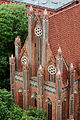 Eastern gable of church of St. James in Toruń (14th century)
-
 Decorative pattern made of strongly fired bricks in Radzyń Castle (14th century)
-
 Brick sculpting on Thornbury Castle, Thornbury, near Bristol, England. The chimneys were erected in 1514
-
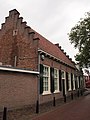 A typical brick house in the Netherlands.
-

-
 Decorative bricks in St Michael and All Angels Church, Blantyre, Malawi
-

-
 Brick sidewalk paving in Portland, Oregon
-
 Closeup of brick sidewalk in Cambridge, Massachusetts
-
 Porotherm style clay block brick
-
 Moulding bricks, Poland
-

-
 Fired, clay bricks in Hainan, China


See also
References
- Romero, Simon (6 October 2007). "Rogelio Salmona, Colombian Architect Who Transformed Cities, Is Dead at 78". The New York Times.
Further reading
- Aragus, Philippe (2003), Brique et architecture dans l'Espagne médiévale, Bibliothèque de la Casa de Velazquez, 2 (in French), Madrid
- Campbell, James W.; Pryce, Will, photographer (2003), Brick: a World History, London & New York: Thames & Hudson
- Coomands, Thomas; VanRoyen, Harry, eds. (2008), "Novii Monasterii, 7", Medieval Brick Architecture in Flanders and Northern Europe, Koksijde: Ten Duinen
- Das, Saikia Mimi; Das, Bhargab Mohan; Das, Madan Mohan (2010), Elements of Civil Engineering, New Delhi: PHI Learning Private Limited, ISBN 978-81-203-4097-8
- Kornmann, M.; CTTB (2007), Clay Bricks and Roof Tiles, Manufacturing and Properties, Paris: Lasim, ISBN 2-9517765-6-X
- Plumbridge, Andrew; Meulenkamp, Wim (2000), Brickwork. Architecture and Design, London: Seven Dials, ISBN 1-84188-039-6
- Dobson, E. A. (1850), Rudimentary Treatise on the Manufacture of Bricks and Tiles, London: John Weale
- Hudson, Kenneth (1972) Building Materials; chap. 3: Bricks and tiles. London: Longman; pp. 28–42
- Lloyd, N. (1925), History of English Brickwork, London: H. Greville Montgomery
External links
 |
Wikiquote has quotations related to: Bricks |
 |
Look up bricks in Wiktionary, the free dictionary. |
 |
Wikimedia Commons has media related to Bricks. |
 "Brick". Encyclopædia Britannica. 4 (11th ed.). 1911.
- Brick in 20th-Century Architecture
- Brick Industry Association United States
- Brick Development Association UK
- Think Brick Australia
- International Brick Collectors Association
Comments
Post a Comment