Tile
Tile

Mid-16th-century decorative tilework on the Dome of the Rock, Jerusalem

Azulejos by Willem van der Kloet (1708) in the transept of the Church of Nossa Senhora da Nazaré; Nazaré, Portugal
Tiles are often used to form wall and floor coverings, and can range from simple square tiles to complex or mosaics. Tiles are most often made of ceramic, typically glazed for internal uses and unglazed for roofing, but other materials are also commonly used, such as glass, cork, concrete and other composite materials, and stone. Tiling stone is typically marble, onyx, granite or slate. Thinner tiles can be used on walls than on floors, which require more durable surfaces that will resist impacts.
Contents
Decorative tile work and coloured brick

Blue Turkish tiles
History
 |
The examples and perspective in this article may not represent a worldwide view of the subject. (August 2016) (Learn how and when to remove this template message)
|
Tiling was used in the second century by the Sinhalese kings of ancient Sri Lanka, using smoothed and polished stone laid on floors and in swimming pools. Historians consider the techniques and tools for tiling as well advanced, evidenced by the fine workmanship and close fit of the tiles.[citation needed] Tiling from this period[dubious ] can be seen in Ruwanwelisaya and Kuttam Pokuna in the city of Anuradhapura.

Relief made with glazed brick tiles, from the Achaemenid decoration of Persepolis.
The succeeding Sassanid Empire used tiles patterned with geometric designs, flowers, plants, birds and human beings, glazed up to a centimeter thick.[1]


Tumurid turquoise-glazed muqarna. First half of the 15th century, Shah-i-Zinda
Other important tile techniques of this time include girih tiles, with their characteristic white girih, or straps.
Mihrabs, being the focal points of mosques, were usually the places where most sophisticated tilework was placed. The 14th-century mihrab at Madrasa Imami in Isfahan is an outstanding example of aesthetic union between the Islamic calligrapher's art and abstract ornament. The pointed arch, framing the mihrab's niche, bears an inscription in Kufic script used in 9th-century Qur'an.[2]
One of the best known architectural masterpieces of Iran is the Shah Mosque in Isfahan, from the 17th century. Its dome is a prime example of tile mosaic and its winter praying hall houses one of the finest ensembles of cuerda seca tiles in the world. A wide variety of tiles had to be manufactured in order to cover complex forms of the hall with consistent mosaic patterns. The result was a technological triumph as well as a dazzling display of abstract ornament.[2]
During the Safavid period, mosaic ornaments were often replaced by a haft rang (seven colors) technique. Pictures were painted on plain rectangle tiles, glazed and fired afterwards. Besides economic reasons, the seven colors method gave more freedom to artists and was less time-consuming. It was popular until the Qajar period, when the palette of colors was extended by yellow and orange.[1] The seven colors of Haft Rang tiles were usually black, white, ultramarine, turquoise, red, yellow and fawn.

-

-
 Enderun library, Topkapi Palace
-
 Window Apartments of the Crown Prince, Topkapi Palace


Phoenix on the portal of Nadir Divan-Beghi Madrasah, Bukhara, Uzbekistan


-
 Quadra (architecture) of St. John the Baptist covered with azulejos in carpet style (17th c.); Museu da Reinha D. Leonor; Beja, Portugal.
-
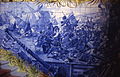 The Battle of Buçaco, depicted in azulejos.


Medieval encaustic tiles at Cleeve Abbey, England
Medieval Europe made considerable use of painted tiles, sometimes producing very elaborate schemes, of which few have survived. Religious and secular stories were depicted. The imaginary tiles with Old testament scenes shown on the floor in Jan van Eyck's 1434 Annunciation in Washington are an example. The 14th century "Tring tiles" in the British Museum show childhood scenes from the Life of Christ, possibly for a wall rather than a floor,[3] while their 13th century "Chertsey Tiles", though from an abbey, show scenes of Richard the Lionheart battling with Saladin in very high-quality work.[4] Medieval letter tiles were used to create Christian inscriptions on church floors.

17th century Delft blue and white tile with seamonster
There are several other types of traditional tiles that remain in manufacture, for example the small, almost mosaic, brightly colored zellige tiles of Morocco and the surrounding countries. With exceptions, notably the Porcelain Tower of Nanjing, decorated tiles or glazed bricks do not feature largely in East Asian ceramics.

William de Morgan, fantastic ducks on 6-inch tile with luster highlights, Fulham period
Since the Victorian period tiles have remained standard for kitchens and bathrooms, and many types of public area.

A late Art Nouveau kiosk (1923) in Las Palmas de Gran Canaria covered with tiles from Manises, Spain.
.jpg)

.jpg)
Notable among American tilemakers of the 1920s and 1930s were Ernest A. Batchelder and Pewabic Pottery.
Roof tiles

Roofs with "beaver tail" tiles in Dinkelsbühl, Germany
Floor tiles

Making mosaic tiles

The elaborate floor pattern of the Sydney Queen Victoria Building

Floor tile in Karpas, northeastern Cyprus

6"x6" porcelain floor tiles

Natural stone tiles can be beautiful but as a natural product they are less uniform in color and pattern, and require more planning for use and installation. Mass-produced stone tiles are uniform in width and length. Granite or marble tiles are sawn on both sides and then polished or finished on the top surface so that they have a uniform thickness. Other natural stone tiles such as slate are typically "riven" (split) on the top surface so that the thickness of the tile varies slightly from one spot on the tile to another and from one tile to another. Variations in tile thickness can be handled by adjusting the amount of mortar under each part of the tile, by using wide grout lines that "ramp" between different thicknesses, or by using a cold chisel to knock off high spots.
Some stone tiles such as polished granite, marble, and travertine are very slippery when wet. Stone tiles with a riven (split) surface such as slate or with a sawn and then sandblasted or honed surface will be more slip-resistant. Ceramic tiles for use in wet areas can be made more slip-resistant either by using very small tiles so that the grout lines acts as grooves or by imprinting a contour pattern onto the face of the tile.
The hardness of natural stone tiles varies such that some of the softer stone (e.g. limestone) tiles are not suitable for very heavy-traffic floor areas. On the other hand, ceramic tiles typically have a glazed upper surface and when that becomes scratched or pitted the floor looks worn, whereas the same amount of wear on natural stone tiles will not show, or will be less noticeable.
Natural stone tiles can be stained by spilled liquids; they must be sealed and periodically resealed with a sealant in contrast to ceramic tiles which only need their grout lines sealed. However, because of the complex, nonrepeating patterns in natural stone, small amounts of dirt on many natural stone floor tiles do not show.
The tendency of floor tiles to stain depends not only on a sealant being applied, and periodically reapplied, but also on their porosity or how porous the stone is. Slate is an example of a less porous stone while limestone is an example of a more porous stone. Different granites and marbles have different porosities with the less porous ones being more valued and more expensive.
Most vendors of stone tiles emphasize that there will be variation in color and pattern from one batch of tiles to another of the same description and variation within the same batch. Stone floor tiles tend to be heavier than ceramic tiles and somewhat more prone to breakage during shipment.
Rubber floor tiles have a variety of uses, both in residential and commercial settings. They are especially useful in situations where it is desired to have high-traction floors or protection for an easily breakable floor. Some common uses include flooring of garage, workshops, patios, swimming pool decks, sport courts, gyms, and dance floors.
Plastic floor tiles including interlocking floor tiles that can be installed without adhesive or glue are a recent innovation and are suitable for areas subject to heavy traffic, wet areas and floors that are subject to movement, damp or contamination from oil, grease or other substances that may prevent adhesion to the substrate. Common uses include old factory floors, garages, gyms and sports complexes, schools and shops.
Ceiling tiles
Ceiling tiles are lightweight tiles used inside buildings. They are placed in an aluminium grid; they provide little thermal insulation but are generally designed either to improve the acoustics of a room or to reduce the volume of air being heated or cooled.Mineral fiber tiles are fabricated from a range of products; wet felt tiles can be manufactured from perlite, mineral wool, and fibers from recycled paper; stone wool tiles are created by combining molten stone and binders which is then spun to create the tile; gypsum tiles are based on the soft mineral and then finished with vinyl, paper or a decorative face.[citation needed]
Ceiling tiles very often have patterns on the front face; these are there in most circumstances to aid with the tiles ability to improve acoustics.[citation needed]
Ceiling tiles also provide a barrier to the spread of smoke and fire. Breaking, displacing, or removing ceiling tiles enables hot gases and smoke from a fire to rise and accumulate above detectors and sprinklers. Doing so delays their activation, enabling fires to grow more rapidly.[6]
Ceiling tiles, especially in old Mediterranean houses, were made of terracotta and were placed on top of the wooden ceiling beams and upon those were placed the roof tiles. They were then plastered or painted, but nowadays are usually left bare for decorative purposes.
Modern-day tile ceilings may be flush mounted (nail up or glue up) or installed as dropped ceilings.
Materials and processes
Ceramic
Ceramic materials for tiles include earthenware, stoneware and porcelain.[citation needed] Terracotta is a traditional material used for roof tiles.[7]Porcelain tiles
This is a US term, and defined in ASTM standard C242 as a ceramic mosaic tile or paver that is generally made by dust-pressing and of a composition yielding a tile that is dense, fine-grained, and smooth, with sharply-formed face, usually impervious. The colours of such tiles are generally clear and bright.[8]Pebble
Similar to mosaics or other patterned tiles, pebble tiles are tiles made up of small pebbles attached to a backing. The tile is generally designed in an interlocking pattern so that final installations fit of multiple tiles fit together to have a seamless appearance. A relatively new tile design, pebble tiles were originally developed in Indonesia using pebbles found in various locations in the country. Today, pebble tiles feature all types of stones and pebbles from around the world.Digital printed
Printing techniques and digital manipulation of art and photography are used in what is known as "custom tile printing". Dye sublimation printers, inkjet printers and ceramic inks and toners permit printing on a variety of tile types yielding photographic-quality reproduction.[9] Using digital image capture via scanning or digital cameras, bitmap/raster images can be prepared in photo editing software programs. Specialized custom-tile printing techniques permit transfer under heat and pressure or the use of high temperature kilns to fuse the picture to the tile substrate. This has become a method of producing custom tile murals for kitchens, showers, and commercial decoration in restaurants, hotels, and corporate lobbies.Diamond etched
A method for custom tile printing involving a diamond-tipped drill controlled by a computer. Compared with the laser engravings, diamond etching is in almost every circumstance more permanent.[citation needed]Mathematics of tiling
Certain shapes of tiles, most obviously rectangles, can be replicated to cover a surface with no gaps. These shapes are said to tessellate (from the Latin tessella, 'tile') and such a tiling is called a tessellation. Geometric patterns of some Islamic polychrome decorative tilings are rather complicated (see Islamic geometric patterns and, in particular, Girih tiles), even up to supposedly quaziperiodic ones, similar to Penrose tilings.Further reading
- Carboni, S. & Masuya, T. (1993). Persian tiles. New York: The Metropolitan Museum of Art.
- Marilyn Y. Goldberg, "Greek Temples and Chinese Roofs," American Journal of Archaeology, Vol. 87, No. 3. (Jul., 1983), pp. 305–310
- Örjan Wikander, "Archaic Roof Tiles the First Generations," Hesperia, Vol. 59, No. 1. (Jan.–Mar., 1990), pp. 285–290
- William Rostoker; Elizabeth Gebhard, "The Reproduction of Rooftiles for the Archaic Temple of Poseidon at Isthmia, Greece," Journal of Field Archaeology, Vol. 8, No. 2. (Summer, 1981), pp. 211–227
- Michel Kornmann and CTTB, "Clay bricks and roof tiles, manufacturing and properties", Soc. Industrie Minerale, Paris (2007) ISBN 2-9517765-6-X
- E-book on the manufacture of roofing tiles in the United States from 1910.
See also
 |
Wikimedia Commons has media related to Tiles. |
References
- "Inkjet Decoration of Ceramic Tiles". digitalfire.com. Retrieved July 28, 2010.
 |
Look up tile in Wiktionary, the free dictionary. |
Comments
Post a Comment